
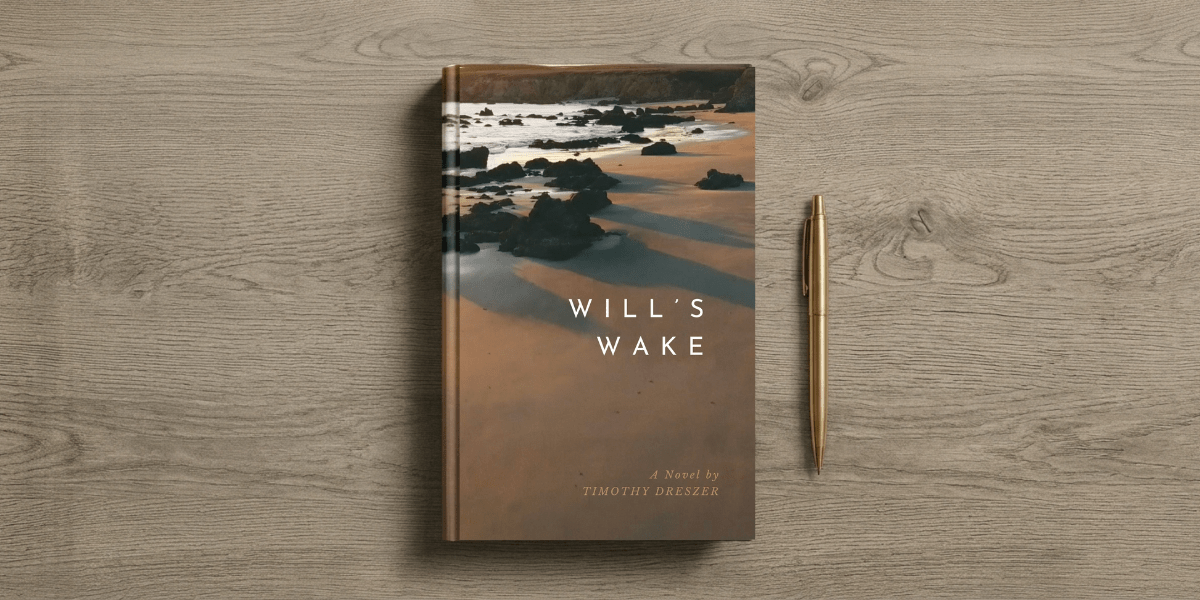
Will’s Wake turns family fracture, friendship, and fear into a haunting coming-of-age story.
Under the redwoods near the Pacific, where fog can make a morning feel half dreamed, Timothy Dreszer found the imaginative weather that would one day shape Will’s Wake. The debut novel did not begin as a neat literary plan. It gathered force from a life marked by rupture, science, distance, humor, and the stubborn need to understand what children survive when adults fail them.
Emotions Become Monsters in the Mind of a Child
For Dreszer, the novelist behind the Umgapa Sky imprint, the story grew out of contrast. He was raised in Houston, close enough to NASA’s orbit to feel the pull of inquiry and ambition. Yet his childhood also carried a private fracture. He was seven when his parents divorced, and was forced to live with his tense, unhappy mother and a bullying older brother. By twenty, when that brother was diagnosed with paranoid schizophrenia, Dreszer understood that pain, absurdity, intimacy, and helplessness can exist in the same room. He has described learning to appreciate the poetic humor in his own “tortured” life, a phrase that suggests not self-pity, but appreciation that his own demons were mild in the shadow of others.
That emotional history matters because Will’s Wake is not written from abstraction. It is fiction, but it carries the weight of lived observation. The novel follows two children, Shree and Wendy, as they navigate danger, confusion, and the aching gap between what adults promise and what they can provide. It is part descent into psychosis and part ode to friendship, a balance that gives the book its unsettling force.
In the novel’s climactic storm, eleven-year-old Shree is trapped with her father beneath ancient redwoods. Power is gone. Food has run out. A river of mud has erased the road to safety. Her father, Tony, is hiding a worsening inner crisis, and as voices torment him, a child’s world becomes smaller, more confusing, and dangerous.
Wendy, bonded to Shree by a friendship forged in the pain of dysfunctional families, has her own worries. When Shree disappears with her mythical father, Wendy must face her insecurities and tormentors on her own. Then a secret letter from Shree arrives, and becomes a fragile shield against her cruel classmates.
What Readers Are Saying
Early readers have responded with rare intensity. One called it “a nerve-shredding, unforgettable read.” Another praised it simply as “beautifully written.” The reactions point again and again to the same quality, a deep and believable humanity. As one reader put it, “What sold this book for me was how human everybody felt.”
Others have reached for larger comparisons. “I can honestly say that I’ve never read a book quite like Will’s Wake,” one wrote. Reviewers have noted “real talent on display here” and observed that “the author handles the subject with sensitivity, insight, and emotional depth.” Perhaps the most striking response of all came from a reader who predicted, “I can see this becoming a classic.” For a debut novelist, such words are both rare and hard-won.
From Science To Storytelling
Escaping family strain and Houston’s suffocating humidity, Dreszer sought refuge in the redwoods on the edge of the Pacific. Nature gave him space. Science gave him structure. Engineering gave him method. Over time, his studies and career carried him from psychology to biology to bioinformatics. Yet while his head was occupied with code and scientific papers, his heart was building stories colored by complicating human emotions.
That technical background informs but doesn’t fuel his voice. Instead, the tension between cerebral and emotional gives precision to the novel’s psychological upheaval. The prose is never clinical, but observant and fluid. The drama is chaotic, yet never senseless. In one scene, we learn that the sculpted beauty of a stream is partially due to hydrogen bonds. In another, the evolution of transcendent experiences is considered. The novel inhabits the minds of its characters as they experience wonder, fear, angst, embarrassment, infatuation, and paranoia. Dreszer accomplishes this with an unexpectedly logical authenticity,
What Makes Will’s Wake Different Today
There is no shortage of coming-of-age fiction, but Will’s Wake stands apart because it refuses easy categories. It braids with divergent threads that rarely share a page: the interior descent of a mind unraveling, the tender, stubborn loyalty of childhood friendship, together the first stirrings of maturity, self-definition, and the responsibility of choice. Most novels choose one register. Dreszer interweaves genres, letting dread and hope press against each other until the reader cannot tell which will win.
The title itself suggests aftermath. A wake can mean the track left behind a body moving through water. It can also mean mourning, the end of sleep, or the beginnings of awareness. In Dreszer’s hands, that layered meaning fits a story in which children live in the wake of adult choices. The book asks whether they can find the will to act when loyalty and betrayal may be the same thing.
That question gives the book its moral urgency. Dreszer does not write childhood as innocence preserved under glass. He writes it as a place where intelligence, imagination, deception, and betrayal appear early. Shree and Wendy are young, but they are not passive. They, like all of the characters, are off-balance and struggling to do the right thing. Yet everyone is isolated in their own point of view. That is why their friendship is a lifeline. They search for belonging and rescue in a world we recognize, even if we can’t help them.
For readers looking for fiction that treats young people as emotionally complex, family pain as inevitable, and mental illness as recognizable even when it’s beyond understanding, Will’s Wake offers a memorable experience. Explore Timothy Dreszer’s debut novel, read the early responses, and step into a story that might just become a classic. Or maybe just an enjoyable read that lingers long after the closing words.
Explore More About Umgapa Sky
Connect with Will’s Wake on Amazon, everywhere else, Instagram, and YouTube.