

An ambitious philosophical work introduces a multidimensional model that redefines how civilizations evolve, expanding beyond technology into consciousness.
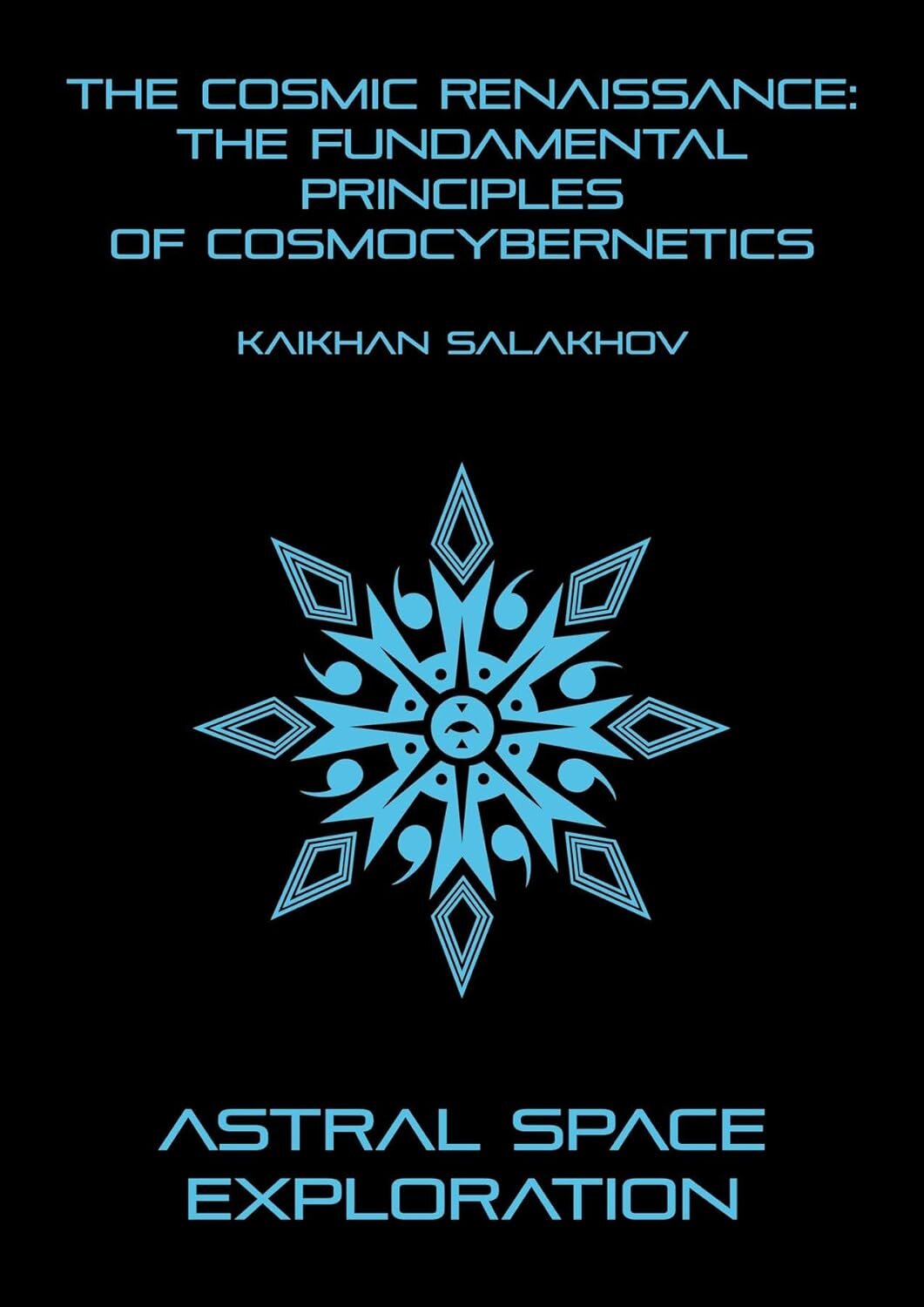
In a quiet studio shaped by years of disciplined craft, Kaikhan Salakhov — grandson of renowned Azerbaijani artist Tahir Salakhov — spent seven years constructing something that resists easy categorization. What emerged was not simply a book, nor only an exhibition, but a unified intellectual and visual system. Astral Space Exploration: The Cosmic Renaissance: The Fundamental Principles of Cosmocybernetics stands as both an 852-page philosophical treatise and the conceptual foundation behind a 2024 solo exhibition of thirty-six paintings at Firetti Contemporary. Together, they form a single project that challenges how humanity defines civilizational progress itself.
At the center of this work is a claim that can be verified by surveying the existing literature: no comprehensive model has ever been proposed that systematically integrates stages of consciousness development with stages of space exploration, technological progression, and civilizational evolution into a single multidimensional framework. The ASX Grid is the first.
The ASX Grid And The Missing Dimension Of Consciousness
The core innovation of Astral Space Exploration Cosmocybernetics is the ASX Grid, a multidimensional model that integrates consciousness into civilizational measurement. Where traditional systems such as the Kardashev Scale focus on energy consumption, the ASX Grid introduces a parallel architecture that evaluates awareness, ethics, and spiritual development alongside technological capability.
The scientific models ignore consciousness. The philosophical models ignore cosmic expansion. None integrates both into a unified architecture. And all of them share a deeper structural limitation: they are anthropocentric and species-centric, projecting human cognition and human technological history as the universal template for all possible civilizational development.
The consequence of this gap is not academic. A civilization that harnesses the total energy output of a star — Type II on the Kardashev Scale — while operating with the moral and spiritual architecture of a predatory species would be classified as advanced by every existing metric. The ASX Grid classifies it as catastrophically dangerous. A civilization’s Kardashev classification without a corresponding consciousness classification is not a measurement of progress. Because progress is in itself a relative concept, one that is purely anthropocentric; what constitutes progress for humanity may not be so for other forms of life in the universe. Yet even within human culture, external development that lacks spiritual depth cannot be called progress. This shift transforms the meaning of advancement. A society capable of harnessing immense energy is no longer automatically advanced. Its stage of consciousness determines whether that power becomes a tool for liberation or a mechanism of control. Technology, in this system, is no longer neutral. It becomes an expression of the consciousness directing it.
The ASX Grid maps development across eight stages, from pre-planetary existence to universal scale, while simultaneously tracking multiple interconnected dimensions. These include technological systems, energy structures, economic models, biological evolution, cultural transformations and spiritual development, the properties of consciousness, levels and lines of consciousness development, and forms of perception. None operate in isolation. Each influences and reshapes the others, producing a far more realistic picture of how civilizations evolve. It simultaneously accommodates possible xenocultural intelligences whose cognition may be non-linear and exist beyond any form of categorisation and not fit into any human-centred models.
This is what makes the ASX Grid unprecedented. It is not anthropocentric — it does not assume human consciousness as the baseline or the ceiling. It is not species-centric — it does not project one species’ developmental trajectory as a universal template. And it treats consciousness not as a philosophical luxury but as a civilizational survival metric — the single most important variable determining whether a civilization’s expansion into space is a contribution to the cosmos or a threat to it.
Three Paths That Could Divide Humanity
One of the most rigorous aspects of the book is its taxonomy of human developmental divergence. Rather than assuming a unified path into the future, the work identifies three primary trajectories that would shape every dimension of a colony’s existence — governance, economy, spirituality, biology, architecture, diplomacy, and identity itself.
Biocentric — civilizations prioritizing organic biological evolution, rejecting or limiting synthetic augmentation, adapting through natural processes and genetic selection within organic parameters. Biology is the medium of evolution, not technology.
Technocentric — civilizations embracing cybernetic enhancement, neural-digital integration, artificial organ systems, cognitive augmentation, and potentially full substrate transfer of consciousness into synthetic platforms. Technology is not a tool — it is the medium through which the species evolves.
Biomechanical — civilizations pursuing a deliberate fusion of biological and mechanical systems where neither component is subordinate. Organisms that are simultaneously biological and synthetic, with neither aspect extractable from the other.
Each trajectory generates subsequent variants. The compounding factor is the stellar environment. The same trajectory produces fundamentally different biological outcomes under different conditions of gravity, radiation, atmospheric composition, and light spectrum. Two biocentric colonies with identical philosophical commitments would, over generations in different stellar environments, diverge into separate species — despite sharing the same foundational orientation toward organic evolution. The environment does not merely influence the colony. It reshapes the trajectory itself, producing variants within variants across interstellar distances where communication lag is measured in decades or centuries.
The implication is structural, not speculative: expansion into space does not unify humanity. It fragments it along every possible axis simultaneously — biological, ideological, spiritual, economic, and cognitive. Humans become aliens to one another not through contact with extraterrestrial life, but through the act of expansion itself.
Questions That Challenge The Future Of Civilization
Rather than offering definitive answers, the book structures itself around rigorous and unsettling questions. When a technocentric technocratic colony mandating cognitive augmentation as a condition of citizenship encounters a biocentric theocratic colony criminalizing all synthetic modification — and both regard the other’s foundational principle as an existential threat to the definition of sentient life — what interstellar diplomatic framework can bridge a disagreement that is not political but biological and ontological? When biocentric colonies separated by eighty light-years develop incompatible spiritual traditions shaped by entirely different stellar environments, what mechanism for interfaith dialogue survives a hundred-and-sixty-year round-trip communication delay? If humanity has never achieved sustained peaceful multireligious coexistence on a single planet, what basis exists for assuming it will achieve this across star systems where a single exchange between colonies takes decades?
These questions are grounded in the physics of space rather than speculative fiction. Communication delays, environmental differences, and evolutionary pressures are treated as fundamental constraints that reshape every aspect of civilization.
The underlying concern is clear. Without the parallel development of consciousness, technological expansion risks amplifying existing human dysfunctions. In a boundless environment, unresolved issues do not fade. They scale.
Beyond Human Centered Models
Astral Space Exploration Cosmocybernetics stands apart in its insistence that human experience is not the universal template. The ASX Grid is built to evaluate any form of sentient development, whether biological, synthetic, or entirely unknown.
This approach allows for the possibility that future encounters will not be between humanity and a singular alien species, but between a spectrum of post-human and non-human intelligences, each shaped by radically different interstellar conditions and modes of awareness.
In that context, the concept of a unified human civilization may dissolve entirely. What replaces it is a complex network of divergent intelligences navigating coexistence across vast distances and incompatible realities.
A New Framework For Cosmic Responsibility
The significance of Astral Space Exploration is not only its originality but its timing. As public discourse around space colonization accelerates — driven by corporate ambition and geopolitical competition — the question of what humanity is exporting into space becomes increasingly urgent.
The ASX Grid introduces a standard that no prior framework has attempted: advancement measured not by power, reach, or control, but by the quality of consciousness directing those capabilities. By this measure, a civilization that commands the energy of a star but cannot command the awareness to use it without harm is not advanced. It is a civilization-scale hazard operating without the metric that would reveal it as such.
The future of expansion depends not on how far a particular species can spread, but on what it becomes in the process of spreading and on the fundamental principles driving that expansion. ASX Grid is the first conceptual model developed to assess all these factors.
Explore The Cosmocybernetics Project
Readers, collectors, and thinkers interested in Astral Space Exploration: Cosmocybernetics can explore the full project through its official platform at astralspacex.com. The complete book is available via Amazon. The exhibition and gallery representation can be explored through Gallery: Firetti Contemporary, while the artist’s portfolio is available on Artsy.
Further insight into the artistic philosophy and process appears in a published feature at hube magazine interview, and ongoing updates can be followed through the artist’s official Instagram.
For those seeking a deeper understanding of humanity’s future in the cosmos, this work offers not just a theory, but a lens through which the next era of civilization can be examined and reimagined.