

Ancient discoveries challenge our understanding of civilization’s origins, urging us to rethink history and its lessons.
By Reverend Bryan Gallan
For centuries, humanity has told itself a simple story about its origins. Civilizations rose. They fell. We inherited what remained.
But what if that story is incomplete?
Over the last decade, discoveries at sites such as Göbekli Tepe in Turkey, unexplained anomalies emerging from the Amazon basin, and new data coming from beneath the Antarctic ice have begun to challenge long-held assumptions about when civilization truly began — and what may have existed before recorded history.
These are no longer fringe questions. They are legitimate lines of inquiry now being examined by archaeologists, geologists, and researchers using technologies that previous generations could only imagine.
And yet, the deeper the questions go, the quieter the conversation becomes.
When Science Meets Silence
Modern tools such as ground-penetrating radar, satellite mapping, AI-assisted pattern analysis, and advanced carbon dating are revealing structures and data that strain conventional historical timelines. Evidence suggests the presence of organized activity at scales and dates that should not exist according to accepted models of human development.
The implications are enormous.
If human civilization is older and more complex than we believe, then our understanding of progress, collapse, and survival must evolve with it.
But such conversations rarely reach the mainstream.
Why We Resist the Past
Human societies are built on shared narratives. Many of our political, philosophical, and cultural assumptions depend on the belief that we are the most advanced iteration of ourselves.
The idea that sophisticated cultures may have existed, collapsed, and been erased long before us is deeply unsettling. It challenges the myth of linear progress and forces us to confront a more cyclical, fragile view of human existence.
History becomes less a record of advancement and more a warning.
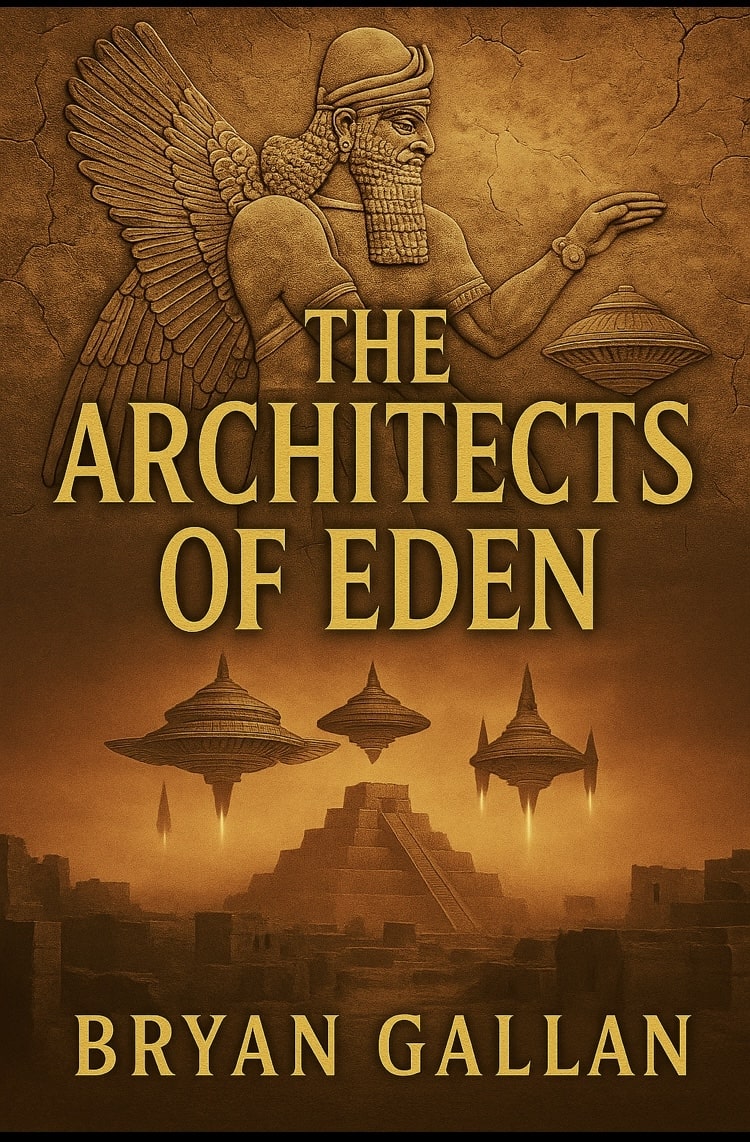
The Role of Storytelling in Exploring Forbidden Questions
This is the approach taken by The Reverend Bryan Gallan, a former British Army medical leader and registered paramedic, whose professional life has been grounded in critical decision-making, academic study, peer-review culture, and human crisis at its most extreme.
After leaving active service, Rev Bryan devoted himself to the study of ancient civilizations, lost knowledge traditions, and the emerging technologies now reshaping archaeology and historical analysis.
Alongside his medical and military career, Reverend Bryan Gallan is also a Master Freemason, with a long-standing interest in symbolism, moral philosophy, and the traditions that have shaped Western civilization — influences that subtly inform the depth and historical layering of his work.
Rather than writing academic papers alone, Reverend Gallan chose a different vehicle for exploration: the techno-thriller.
His novel, Architects of Eden, weaves real archaeological sites, emerging technologies, and suppressed historical questions into a narrative that challenges readers to reconsider humanity’s origins, its vulnerabilities, and its future.
But the novel is only the surface.
The deeper purpose is conversation.
Why This Matters Now
We are entering an era of unprecedented discovery. Artificial intelligence is helping decode ancient languages. Satellites are scanning regions of the planet that have never been mapped with precision. Retreating ice is exposing landscapes hidden for millennia.
At the same time, global systems — political, economic, environmental — feel increasingly fragile.
Understanding how past civilizations rose and collapsed is no longer academic curiosity. It may be essential knowledge for our survival.
History is not simply what happened. It is what we choose to remember.
And the greatest risk to humanity may not be what we do not know — but what we refuse to ask.
“As an ordained minister, my novels explore spiritual themes through story.”
“They are not scripture and they are not doctrine — they are human attempts to wrestle with meaning.”