Who Gets To Adapt? Robert W. Collin Examines The Growing Climate Divide
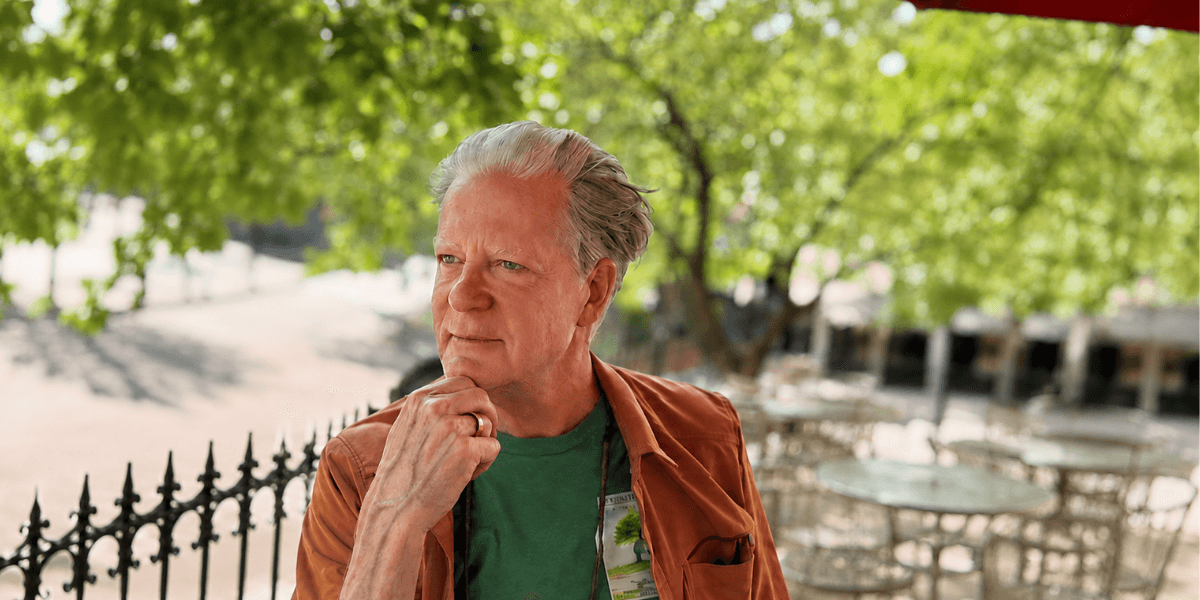
Robert W. Collin’s Who Gets to Adapt? asks who can afford climate resilience and what a fairer path to adaptation could look like.
Who Gets To Adapt?
When a heat wave arrives, the temperature does not ask whether someone owns a home, works outdoors, rents an apartment, or has the resources to recover from a disaster. Yet the consequences of climate change can look dramatically different from one household to another.
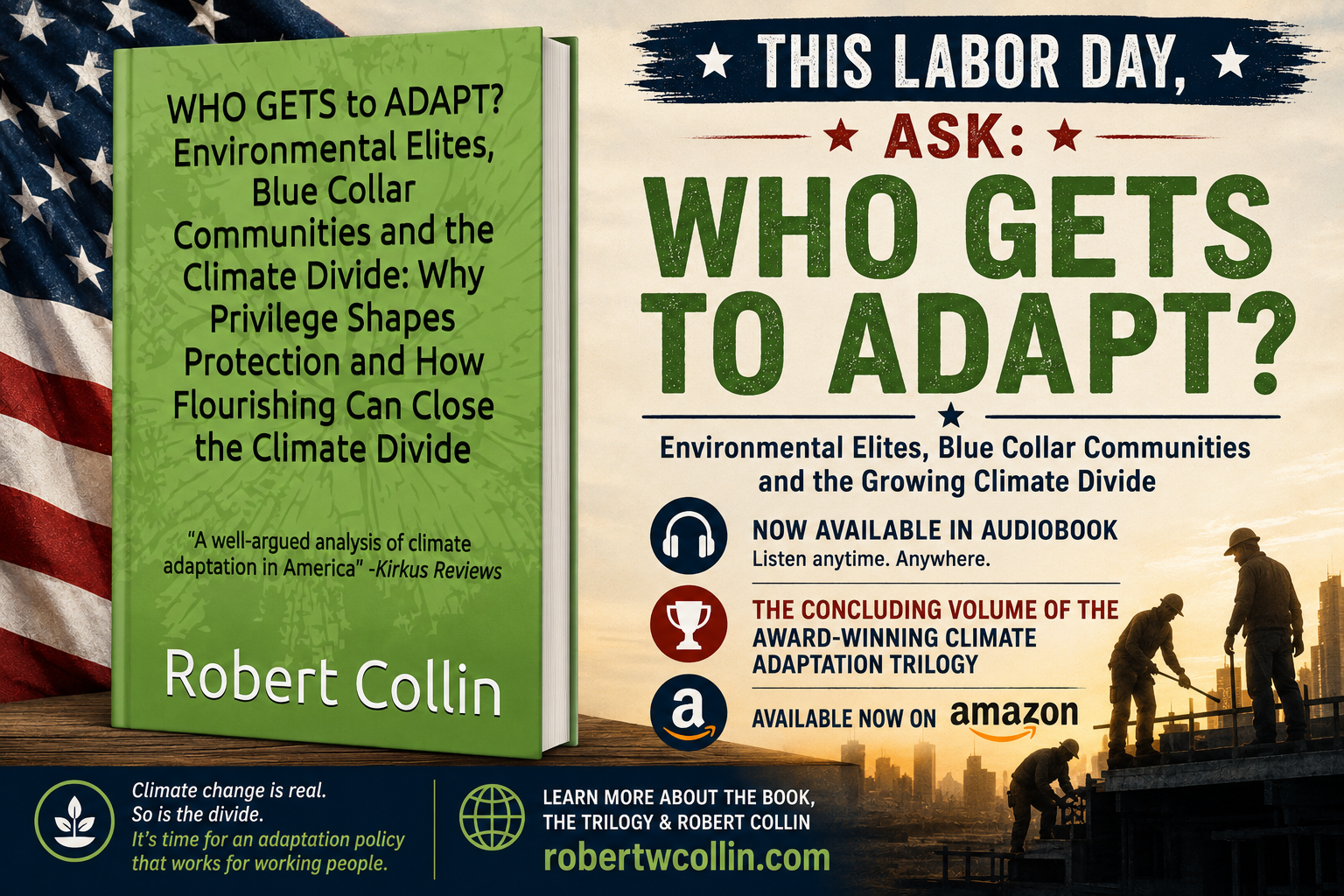
That question sits at the heart of Who Gets to Adapt? Environmental Elites, Blue Collar Communities and the Growing Climate Divide, the latest book from environmental policy scholar and author Robert W. Collin. Published in 2026, the book is the third and concluding volume in Collin’s Climate Adaptation Trilogy, one of the relatively few nonfiction climate trilogies in print and a distinctive three-book examination of climate education, adaptation, and environmental justice. Kirkus Reviews described the book as “a well argued analysis of climate adaptation in contemporary America” and praised its ability to reframe the climate conversation around broader social implications.
For Collin, the issue is not simply whether communities can become more resilient. It is whether the benefits of adaptation are reaching the people who face the greatest exposure and have the fewest options. His argument focuses attention on workers, blue-collar families, renters, rural communities, and others who may have less ability to relocate, upgrade housing, secure favorable insurance, or absorb the financial consequences of climate-related disruption. The book explores how infrastructure investment, land use, insurance, and other systems can shape who receives protection and who remains exposed.
“The defining question of the climate era is no longer simply whether we will adapt. It is who gets to adapt.” — Robert W. Collin
From Climate Resilience To Human Flourishing
Collin’s approach has developed across decades of work involving environmental policy, law, urban planning, social work, education, and environmental justice. His broader body of work includes eight books, according to his published biography, and his current platform centers on helping communities understand climate adaptation while keeping human needs at the center of the conversation.
That interdisciplinary background gives Who Gets to Adapt? a distinctive perspective. Rather than presenting adaptation as a purely technical challenge, Collin asks readers to consider the social structures surrounding it. Kirkus notes that the book distinguishes resilience, understood as the ability of a system to absorb shocks and return to baseline, from flourishing, which Collin connects to improvements in people's lives, health, and dignity.
The distinction matters because surviving climate disruption is not necessarily the same as building a better future. A community can withstand a disaster and still face displacement, declining infrastructure, economic pressure, or repeated exposure to hazards. Collin therefore encourages readers to consider a broader standard of success, one that asks whether communities can remain healthy, stable, dignified, and capable of moving forward.
“Working people built our communities. They should not be the last people protected as the climate changes.” — Robert W. Collin
A Trilogy Built Around Adaptation
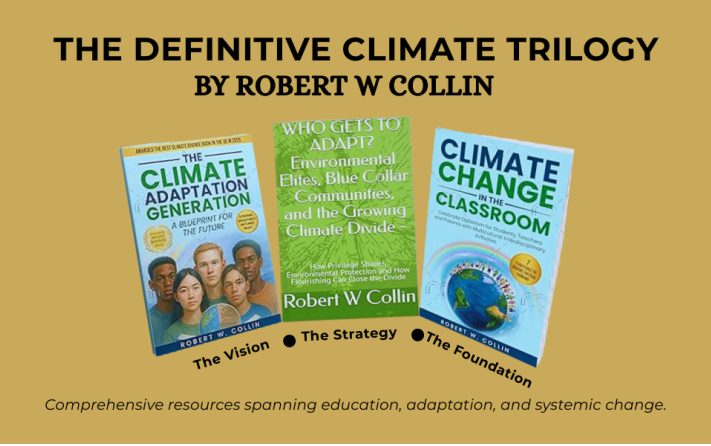
With Who Gets to Adapt? Environmental Elites, Blue Collar Communities and the Growing Climate Divide, Collin completes his Climate Adaptation Trilogy, a distinctive three-book exploration of climate education, preparation, adaptation, and inequality in adaptation. The trilogy is also one of the relatively few nonfiction climate trilogies specifically centered on climate adaptation.
The trilogy was recognized by Best of Best Review as the Best Climate Adaptation Trilogy in the United States of 2026, honoring its distinctive contribution to climate education, adaptation, environmental inequality, and human flourishing.
The earlier The Climate Adaptation Generation: A Blueprint for the Future presents adaptation as a practical challenge for communities, educators, policymakers, and young leaders. The book was recognized by the Evergreen Awards as the Best Environmental Book in the United States for 2025. It also received a Runner Up distinction in the nonfiction category from the PenCraft Book Award Contest.
In 2026, The Climate Adaptation Generation received further recognition when it earned a Silver Award in the 10, Restorative Earth Practices category of the Nautilus Book Awards. The recognition added another distinction to the first volume of the trilogy and underscored the book’s place within a broader conversation about environmental responsibility, climate adaptation, and human flourishing.
The book also earned a place on the 2026 Green Earth Book Award Long List in the Young Adult Non-Fiction category, adding another recognition to its growing list of honors and distinctions.
Collin is also expanding the reach of The Climate Adaptation Generation internationally. The book is forthcoming in Spanish in both ebook and paperback editions, giving Spanish-speaking readers another opportunity to engage with the second volume of the Climate Adaptation Trilogy.
Taken together, the three volumes follow a progression from education and preparation to practical adaptation and, finally, the question of who benefits from adaptation efforts. The trilogy is also distinctive in its arc, which is underscored by optimism and human flourishing, an approach informed by 11 years of global research from Harvard. That progression gives the trilogy a focused structure around the human and social dimensions of responding to climate change.
The trilogy’s final volume shifts the lens toward inequality. In Who Gets to Adapt?, Collin argues that climate adaptation cannot be separated from questions of power, access, occupation, geography, and institutional decision-making. Kirkus describes the book as the final volume of a three-book series and notes that Collin does more than criticize existing systems. The review says he also offers pragmatic solutions.
The result is a body of work designed not only for readers concerned about climate change, but also for educators, planners, policymakers, advocates, and citizens trying to understand how adaptation decisions affect everyday life. Its central question is deliberately simple: Who gets to adapt?
NYC Climate Week Proves The Point
As global leaders, corporations, investors, and environmental organizations gather in New York to shape the climate conversation, Who Gets to Adapt? raises a question Collin believes is too often missing: Who gets the resources and power to adapt—and who gets left behind?
The question reflects a central argument of Collin’s third book, which examines the widening gap between those influencing climate decisions and working communities with fewer resources or access to decision-making spaces. Climate change affects everyone, but the ability to adapt is not distributed equally.
Collin argues that climate resilience also depends on representation and whether adaptation strategies address blue-collar workers, rural communities, renters, and others outside traditional policy circles. Ultimately, Who Gets to Adapt? connects climate resilience with access, power, representation, and economic opportunity.
Why The Climate Divide Matters
The question has become especially relevant as communities confront extreme heat, flooding, wildfire risk, insurance changes, infrastructure pressures, and other forms of climate disruption. Across the Climate Adaptation Trilogy, Collin approaches these challenges from progressively broader perspectives, moving from education and preparation to adaptation and ultimately to the inequalities that can determine who benefits from resilience efforts.
That focus also helps explain what distinguishes Environmental Policy Press. The brand is not built around climate discussion as an abstract exercise. Its published work connects environmental policy with community experience, education, planning, justice, and practical adaptation. Collin’s website describes the mission as helping communities thrive in a changing climate while providing books, tools, and insights intended to bridge the climate adaptation divide.
Reader response has also helped establish a strong reception for Collin’s work. Goodreads currently lists The Climate Adaptation Generation at a 4.79 average rating from 87 ratings, while the author’s combined Goodreads profile shows a 4.77 average across his listed works. Those figures do not establish a universal ranking among environmental nonfiction, but they do demonstrate meaningful reader engagement with the climate adaptation subject.
Explore The Climate Adaptation Conversation
For readers who want to understand climate change through the lens of equity, community capacity, and human flourishing, Who Gets to Adapt? offers a different starting point. Instead of asking only what society should do about climate change, Robert W. Collin asks readers to examine who has the ability to benefit from those solutions.
As the concluding volume of the Climate Adaptation Trilogy, Who Gets to Adapt? brings Collin’s exploration full circle, moving the conversation from preparing for climate change to adapting to it and examining who has the resources and opportunity to benefit from those adaptations.
The audiobook edition is also now available, expanding access to the concluding volume of the trilogy. Readers can explore Robert W. Collin’s books and adaptation resources through Robert W. Collin’s official website, read the Kirkus Reviews assessment of Who Gets to Adapt?, or explore his Amazon author page. Professional updates are also available through LinkedIn and Facebook.
The larger invitation is straightforward: read the question differently. Climate adaptation will affect every community, but the ability to adapt is not distributed equally. By putting working people, community capacity, and human flourishing closer to the center of the discussion, Who Gets to Adapt? challenges readers to consider what a genuinely shared climate future should look like.

NY Review Contributor
Covers sport and entertainment in New York, from the arenas to the stages.
This article features partner, contributor, or branded content from a third party. Members of the NY Review editorial staff were not involved in the creation of this content. All views and opinions are those of the contributor alone.
You May Also Like
Oklahoma City Technologist Daniel Mueller Is an Elite and Competitive Hacker

Ahriana Platten Rewrites Sacred Menopause
Where AI Meets Finance: David Villalobos
Erawan Thai Cuisine Redefines Bayside Thai Dining
Ghina Makari Cane Introduces Let’s Learn Numbers and Counting with Tractors, Diggers and Trucks