
Chuck Beckett Builds the PJ Steele Thrillers Around a Hero Torn Between Two Instincts
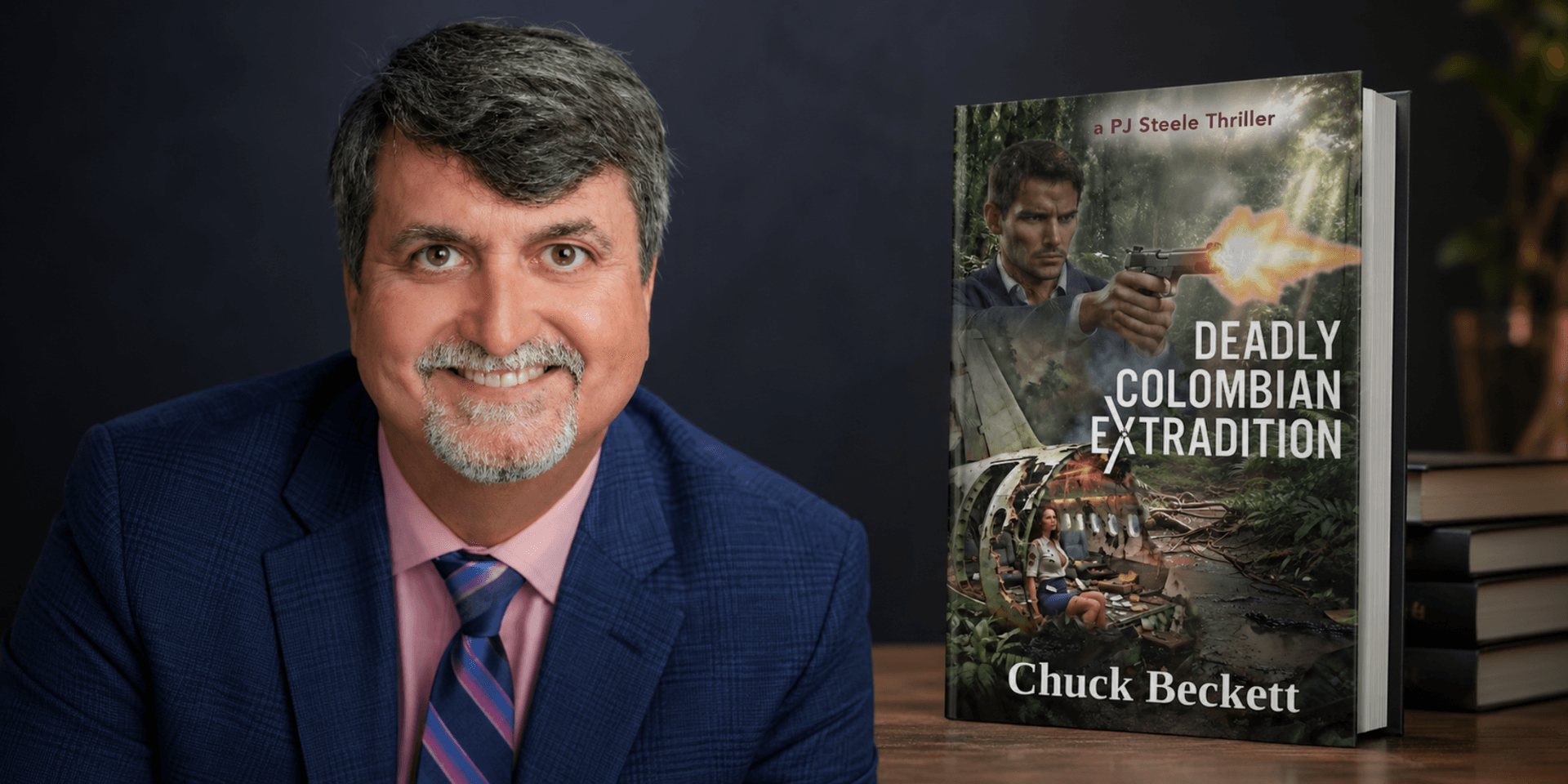
Author Chuck Beckett explores the tension between saving lives and confronting threats through PJ Steele, a pararescue veteran turned U.S. Marshal.
A wounded survivor needs help. Armed adversaries are closing in. The time available to make a decision is shrinking, and choosing the wrong priority could cost multiple lives. For PJ Steele, the fictional protagonist of Chuck Beckett’s thriller series, situations like these are not simply tests of courage. They force him to reconcile two competing instincts: the drive to protect life and the training to eliminate threats.
That tension gives the PJ Steele Thriller series its defining premise. Beckett, a former U.S. Air Force serviceman who later built a career in defense contracting and technology, has created a protagonist whose experience in combat medicine and tactical operations makes him capable of confronting danger from multiple directions. Yet the character’s greatest challenge may be determining how to balance those capabilities when every available choice carries consequences.
Through the series, Beckett combines high-risk missions, international settings, and operational detail with a more personal question: what happens when the skills required to save someone are inseparable from those needed to survive a fight?
The Human Conflict Behind the Action
PJ Steele is a former Air Force Pararescue specialist who becomes a Deputy U.S. Marshal involved in dangerous extradition assignments. His background gives him experience in emergency medicine, tactical operations, and rescuing people from hostile environments.
Those abilities make him a formidable character in action fiction, but Beckett does not present them as interchangeable skills. Saving a wounded person and neutralizing an immediate threat can demand different responses, sometimes at the same moment. PJ must make decisions while weighing the safety of his team, the condition of injured survivors, and the consequences of allowing an adversary to gain the advantage.
This conflict provides a foundation for the series beyond its action sequences. PJ’s training can help him respond to emergencies, but it does not eliminate uncertainty. He must still judge the situation, determine what can be done with limited resources, and decide which risks he can accept.
The result is a protagonist shaped by two responsibilities that can pull in opposite directions. His ability to use force helps him protect others, while his instinct to treat the wounded reminds him why protection matters in the first place.
For readers, this combination creates a different kind of suspense. The question is not only whether PJ will survive a mission, but also whether he can preserve his principles when circumstances make them difficult to uphold.
A Character Inspired by Real Servicemen
The origins of PJ Steele reach back to Beckett’s own time in the U.S. Air Force. He enlisted at nineteen and served for nine years at duty locations around the world. During an assignment in Turkey, he developed a close relationship with the Davis family, including Master Sergeant Cliff Davis, a Vietnam-era medic who had experience with search and recovery teams.
Beckett has described how Davis taught him about search and recovery work, including aspects of underwater navigation and the realities of missions involving life and death. Beckett also cross-trained for base recovery teams and augmentation forces. Those experiences remained with him long after he left military service.
The official PJ Steele Novels website identifies the real servicemen who influenced the character. Beckett has credited Davis’s medical expertise and dedication to saving lives as important elements of the inspiration behind PJ.
The connection helps explain why the protagonist is built around more than combat proficiency. His medical instincts are not an accessory to the action. They are central to how he understands his responsibilities.
Beckett’s own experience also extends beyond military service. He later worked in Department of Defense contracting, security, disaster recovery planning, consulting, and analytics. He is an instrument-rated pilot and certified rescue diver, interests and qualifications that provide additional reference points for writing stories involving aircraft, emergencies, and unfamiliar environments.
These experiences inform the world of the novels, while PJ remains a fictional character whose missions and decisions serve the stories Beckett is telling.
A Colombian Jungle Turns an Extradition Into a Fight for Survival
The first book, Deadly Colombian Extradition, introduces the character through an assignment that quickly becomes a survival crisis.
Deputy U.S. Marshal PJ Steele is escorting cartel accountant Esteban Rojas when the aircraft carrying the prisoner crashes in the Colombian jungle. The wreck leaves roughly two dozen survivors in hostile territory, with cartel gunmen closing in and no assured extraction.
The original assignment has become something far more complicated. PJ must assess injuries, organize the survivors, and find a way to keep the group alive while facing an armed adversary determined to recover the prisoner.
The setting makes the protagonist’s dual role essential. Medical knowledge matters because injured people need immediate attention. Tactical judgement matters because treating those people is difficult when the group remains exposed to danger. The challenges are connected, and progress on one front can create complications on another.
Beckett uses this predicament to bring emergency medicine, movement through hostile terrain, and the logistics of survival into the story. Instead of treating those details as background, the novel makes them part of the choices that determine what happens next.
Readers can find Deadly Colombian Extradition on Amazon Kindle or explore the paperback edition. The book is also listed for sale at Midtown Reader in Tallahassee, Florida.
From the Jungle to the Sahara
The next announced installment, Savage Tunisian Ambush, places PJ in a different landscape while preserving the series’ central conflict.
The assignment begins with a planned prisoner transfer in North Africa. PJ travels to Tunisia to help coordinate the extradition of Karim Al-Mansour, an arms trafficker whose testimony could expose wider criminal networks. The mission becomes a fight for survival when armed militia fighters ambush the team on an isolated desert road.
Cut off and facing wounded companions, PJ must draw on his pararescue background and survival training. The Sahara introduces its own obstacles, including intense heat, limited water, and the difficulty of communicating or securing help while under pursuit.
The new setting expands the series’ operational challenges. In the Colombian jungle, dense terrain and hostile pursuers complicate movement. In the desert, exposure, distance, and scarce resources become equally pressing concerns. In both cases, PJ must think beyond the immediate threat and consider what his team will need to survive the next stage of the mission.
Beckett’s 2025 travels in Egypt and Jordan inspired elements of the second novel’s North African setting. The book is announced for October 2026, extending the series into another environment where the difference between a plan and the reality on the ground can determine who makes it out alive.
Research in Service of the Story
Before turning to thriller writing, Beckett spent approximately 25 years producing professional documents, including proposals, process assessments, security plans, and feasibility studies. His work required research, analysis, and the ability to explain complex systems and future scenarios clearly.
That background offers a useful framework for understanding his approach to fiction. Operational detail must contribute to the story rather than overwhelm it. A technical decision matters when it changes what a character can do, introduces a new risk, or forces a difficult choice.
Beckett’s interest in this kind of grounded storytelling places the PJ Steele series in the tradition of technically detailed military thrillers and fast-paced action fiction. The books are designed for readers who enjoy a combination of dangerous assignments, practical problem-solving, and characters forced to act before they have all the information they would prefer.
His experience does not make every fictional event a record of real operations. Instead, it gives him a foundation for researching the settings, tools, and constraints that shape the fictional missions.
The Next Chapter for PJ Steele
With Deadly Colombian Extradition establishing the protagonist and Savage Tunisian Ambush expanding his world, Beckett is building a series around the consequences of high-pressure decisions. The locations and adversaries change, but PJ’s central dilemma remains: he must confront threats without losing sight of the people he is trying to protect.
Beckett has also developed Violent Luxor Transition, a novella exploring PJ’s origins. According to the author’s website, readers can receive the novella by subscribing to his newsletter with a valid email address.
Readers can learn more about the books, updates, and author through the PJ Steele Novels website, follow Chuck Beckett on Instagram, or connect with him on Facebook.
At the heart of the series is a character who cannot rely on a single skill or instinct to get through a mission. PJ Steele must be decisive enough to confront danger and compassionate enough to recognize the lives at stake. That tension gives Beckett’s thrillers their defining challenge, one that extends beyond the battlefield and into the difficult choices that determine what kind of person a survivor becomes.

NY Review Contributor
Covers sport and entertainment in New York, from the arenas to the stages.
This article features partner, contributor, or branded content from a third party. Members of the NY Review editorial staff were not involved in the creation of this content. All views and opinions are those of the contributor alone.
You May Also Like

Where AI Meets Finance: David Villalobos

Erawan Thai Cuisine Redefines Bayside Thai Dining

Ghina Makari Cane Introduces Let’s Learn Numbers and Counting with Tractors, Diggers and Trucks

IT Intelligent Treatment Brings A New Vision Of Regenerative Aesthetics To New York With SomaCell®

2026 Nobel Prize In Chemistry Honors Henri Kagan And Kenso Soai For Landmark Molecular Discoveries