Akin Famojuro's Freedom In Shackles
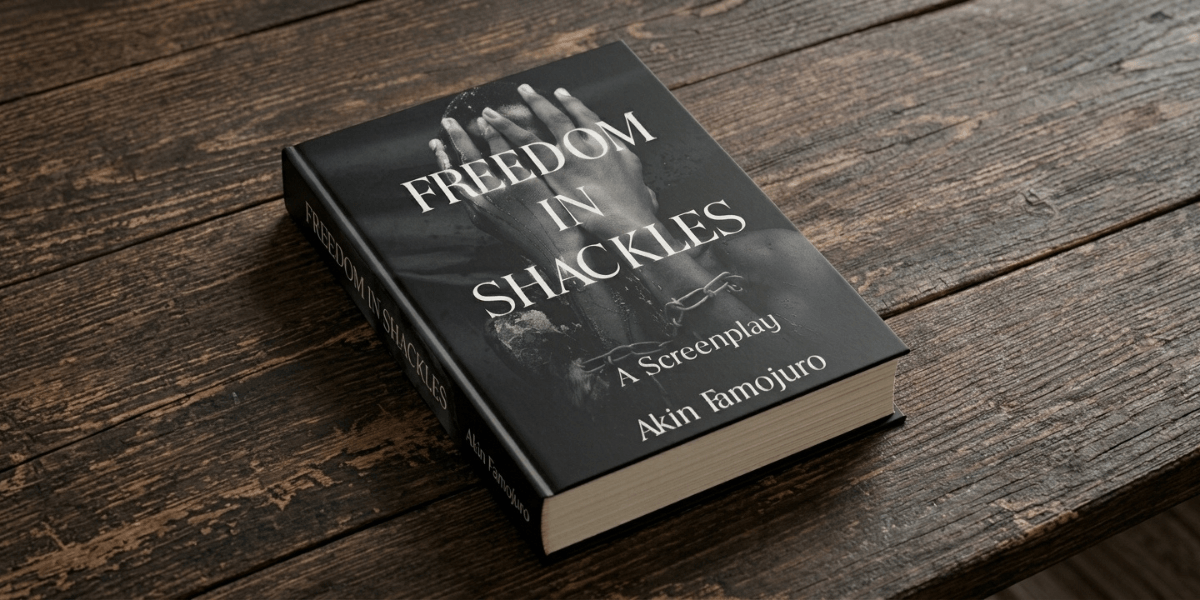
Akin Famojuro turns historical fiction into a vivid fight for identity, memory, and freedom.
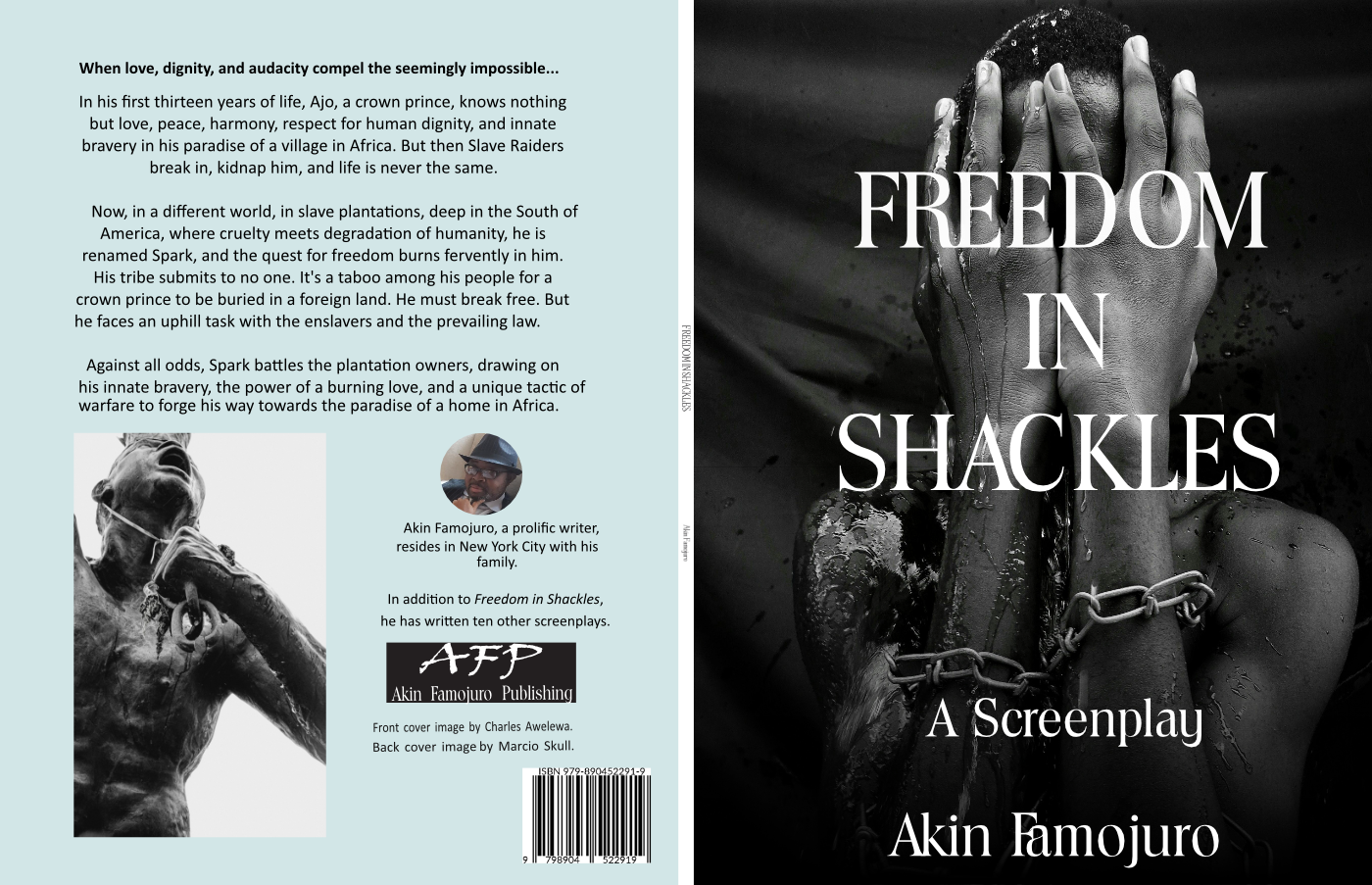
A boy who once knew only peace hears the world break open. In Akin Famojuro’s Freedom In Shackles, Ajo begins life as a crown prince in an African village shaped by dignity, harmony, and courage. Then raiders come. The boy is stolen, renamed Spark, and forced into the brutal machinery of slavery in the American South. Yet the name imposed on him never erases who he is. That tension gives the screenplay its pulse: a human being fighting not only for escape, but for the right to remain himself.
The Mission Behind Freedom In Shackles
Freedom In Shackles is a drama published in screenplay format, available through Amazon and Barnes & Noble. It enters the world of historical fiction with cinematic force, asking readers to see slavery through the consciousness of the oppressed rather than the comfort or cruelty of the oppressor. It is not merely a tale of captivity. It is a study of identity under siege, heritage under threat, and a soul refusing to surrender its origin.
Famojuro, a New York City-based author, brings to the work the instincts of a screenwriter and the discipline of a lifelong observer. He has authored 12 other screenplays and has written, produced, and directed a short film titled One Man’s Medicine, which his peers judged to be the best in his graduating class at New York Film Academy. His academic path crosses cultures and fields, with a Bachelor of Science from the University of Lagos, an Advanced Certificate in Biomedical Informatics from Fordham University, on the New York City Mayor’s Scholarship, and a Master of Science in Biomedical Informatics from Rutgers, The State University of New Jersey.
That background matters because Freedom In Shackles is built with structure and inquiry. It examines systems, power, memory, and the human spirit. Famojuro also regularly contributes spiritual and philosophical essays on Medium, where he explores themes such as Free Will, Human Character, Ability and Talent, Creation and the Law of Balance, the Yoruba Culture, Slavery and Spiritual Bonding, and many more. Those concerns echo through the screenplay, where physical chains become only one form of captivity.
A Crown Prince Renamed, But Not Remade
At the center of Freedom In Shackles is Ajo, whose early life is defined by belonging. He grows up in a paradise of culture, courage, and communal respect. His identity has roots, expectations, and sacred meaning. As a crown prince, he carries not only personal dignity, but the spiritual weight of lineage. Among his people, it is taboo for a crown prince to be buried in a foreign land. That belief becomes his command to survive.
After his abduction, Ajo is renamed Spark on plantations in the American South. The new name is meant to control him, to strip away memory, and to mark him as property. Yet the irony is sharp. Spark is exactly what cannot be contained. His yearning for freedom burns with increasing force, fed by love, heritage, and an unbroken sense of duty to the home stolen from him.
Famojuro’s differentiator is clear. Most stories about slavery are often told from the perspective of the oppressor. Freedom In Shackles turns the lens. It follows the inner and external struggles of the oppressed, with particular attention to what it costs to hold on to identity against all odds. The result is a screenplay that uses historical fiction not as costume, but as confrontation.
The story’s dramatic scenes give that confrontation visual power. In one key moment, Spark flogs a notoriously abusive and cruel master. The scene does not exist for spectacle. It marks a reversal in a world built on humiliation, a moment when terror no longer belongs only to the enslaver. In another scene, Spark fights a wild cougar that is about to kill a master. Even in that dangerous flash of instinct, he sees an opening. Survival becomes strategy. Courage becomes planning. Every action pulls him closer to escape.
This blend of physical danger and inner resolve makes Freedom In Shackles especially suited to readers drawn to historical fiction with moral depth. It has the sweep of a journey, the compressed urgency of a screenplay, and the intimate focus of a character study. Spark’s battle is larger than one man’s flight from bondage. It is a fight against erasure.
Why Historical Fiction Readers Are Responding
Readers often come to historical fiction for immersion, but they stay for recognition. They want to feel the past breathe, then discover that its questions still live in the present. Freedom In Shackles offers that experience through its focus on resilience, heritage, and freedom. It asks what remains when power tries to rename the human spirit. It asks how culture survives when distance, violence, and law are all used as weapons. It asks why the desire for dignity is so fierce that even generations cannot extinguish it.
The screenplay format strengthens those questions. Famojuro writes with a visual eye, which may be why one Amazon reviewer wrote, “This should be a movie already! This level of visual storytelling is beyond excellent.” Freedom In Shackles moves with the charge of cinema. Its scenes invite readers to see the village, the plantation, the danger, the calculation, and the flames of defiance behind Spark’s choices.
Another Amazon reviewer captured the book’s layered appeal: “For me, the book’s title itself already speaks of conflict and combat. This is indeed a good read. Not only has Akin Famojuro crafted a great historical fiction set against the backdrop of 19th-century America, but he has also crafted a powerful exploration of identity, heritage, human resilience, and our unceasing desire for freedom and dignity in this screenplay.”
The title itself contains the contradiction. Freedom and shackles should not coexist, yet history proves that the body can be constrained while the soul remains in rebellion. Spark’s journey is born inside that paradox. His captors can alter his surroundings, his labor, and his name. They cannot fully conquer his memory.
AP News described the work as “Freedom in Shackles Brings a Powerful Story of Courage, Identity, and the Pursuit of Freedom.” That framing fits because the screenplay does not reduce its subject to suffering alone. It recognizes pain, but it also elevates agency. Spark is not written as a passive victim of history. He is a strategist, a son of a people who submit to no one, and a man who understands that returning home is an act of restoration.
For Famojuro, that restoration is both narrative and philosophical. His broader body of writing often returns to the tension between fate and choice, spirit and circumstance, legacy and vanity. Freedom In Shackles channels those concerns into a story that is accessible, dramatic, and emotionally direct. It offers readers the satisfaction of a gripping plot, while inviting deeper reflection on what freedom requires.
The Lasting Power Of Freedom In Shackles
The strongest historical fiction often gives readers two journeys at once. One travels through time and place. The other moves inward, toward questions of conscience. Freedom In Shackles does both. It carries readers from an African village to plantations in the South, but its deepest terrain is Spark’s refusal to let captivity define him.
That refusal is what makes the story timely. In any era, people face forces that try to rename them, reduce them, or cut them off from origin. Famojuro’s screenplay responds with a clear conviction: heritage is not decoration. It is fuel. Memory is not weakness. It is armor. Freedom is not merely a legal condition. It is a longing that shapes action, identity, and destiny.
For readers who seek historical fiction with cinematic pacing, spiritual depth, and a hero driven by more than survival, Freedom In Shackles offers a powerful literary experience. Explore Akin Famojuro’s screenplay and follow Spark’s fight for dignity, heritage, and home.
Explore More About Freedom In Shackles
Connect with Akin Famojuro on Amazon, Barnes & Noble, Medium and Akin Famojuro (@KFahm) / X

NY Review Contributor
Covers sport and entertainment in New York, from the arenas to the stages.
This article features partner, contributor, or branded content from a third party. Members of the NY Review editorial staff were not involved in the creation of this content. All views and opinions are those of the contributor alone.
You May Also Like

Philipp Ruebenhaus on Rethinking Career Growth and Personal Branding

Why The Blank Space is the Best of New York's Immersive Social Clubs
Chuck Beckett Builds the PJ Steele Thrillers Around a Hero Torn Between Two Instincts

Oklahoma City Technologist Daniel Mueller Is an Elite and Competitive Hacker

Ahriana Platten Rewrites Sacred Menopause