Applicans Is Changing College Counseling
A student founder turns college admissions confusion into a personalized platform built for access.
Elijah Gayda-Chelder remembers the feeling with unusual clarity: the deadlines, the essays, the forms, the pressure, and the quiet realization that he did not have the kind of help many students assume they need. Private college counselors could cost thousands of dollars. Families like his had to make hard choices. As he moved through the process unprepared and uncertain, he saw a problem that was bigger than one application season. AI powered college counseling, he believed, could become more than a convenience. It could become a practical way to give students guidance, confidence, and control.
Why AI Powered College Counseling Needed a Student Voice
Applicans began with that personal frustration. Gayda-Chelder was not watching college admissions from a distance. He had just lived it. He knew what it felt like to need advice and not know where to find it. He knew the gap between students who could hire expensive support and students who had to figure out the process alone. That gap became the reason behind Applicans, an AI powered college counseling software program designed to help applicants manage the application journey in one place.
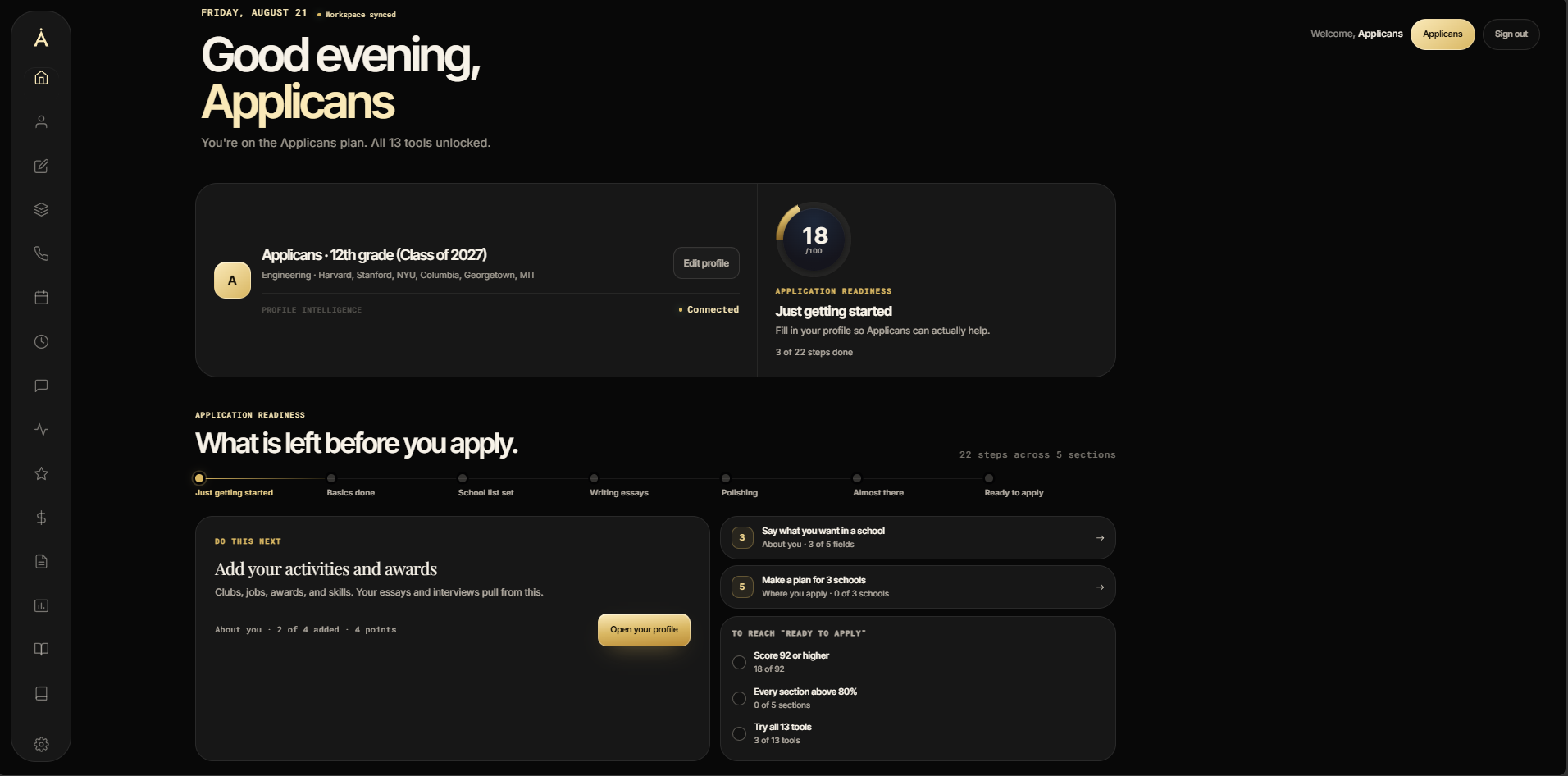
The mission is direct: make quality admissions support easier to access. Applicans is built around a personal profile, where students enter the information that shapes their college journey. From there, the software provides personalized guidance and feedback across the application process. Instead of piecing together disconnected tools, scattered notes, and competing advice, it gives them a dashboard where they can draft essays, explore scholarships, track progress, and move forward with more structure.
The platform includes 13 tools, each designed around the applicant’s own profile. That matters because no two students approach admissions from the same place. A transfer applicant may face different questions than a first-year undergraduate applicant. A professional school applicant may need a different strategy entirely. Applicans was created to support each of those paths without making the user feel like another entry in a database.
Gayda-Chelder’s perspective gives the company its edge. Many admissions products are built with institutions in mind. Applicans was built from the student’s side of the table. “Every student deserves an opportunity to apply to their dream school,” he says. In that sentence is the heart of the company: not a shortcut, not a guarantee, but a belief that preparation should not belong only to families with large budgets.

How Applicans Turns Confusion Into Control
College applications can overwhelm even organized students. Deadlines arrive quickly. Requirements differ by school. Essays demand both polish and honesty. Scholarship searches take time. Recommendations, activity lists, transcripts, and program details can turn into a maze. Applicans responds to that reality with simplicity. Its dashboard is designed to give students one central place to manage the work.
That simplicity is not accidental. Gayda-Chelder spent four months working intensely to release the first version of the software. The goal was not merely to create another digital checklist. It was to build a program that could understand the context of a student’s profile and offer feedback that reflected that context. Students need more than generic reminders. They need guidance that recognizes their goals, background, academic path, and application stage.
The software’s personalization is one of its defining strengths. Applicans takes information from the profile and uses it to support decisions across the process. That kind of structure can help students see what to do next, where to improve, and how to approach each part of the application with more intention. For a student facing a major life step, that clarity can change the emotional experience of applying.
In this sense, AI powered college counseling is not replacing ambition or effort. It is helping students organize both. A strong application still depends on a student’s story, achievements, judgment, and follow-through. Applicans aims to make that work less isolating. As Gayda-Chelder puts it, “One of the biggest applications of your life requires some assistance, that is what Applicans is here for.”
The company’s broader relevance comes at a moment when families are questioning old assumptions about admissions help. The pressure to stand out has grown, but access to expert guidance remains uneven. Students may know they need support, yet hesitate because of cost. Others may not realize what they are missing until late in the process. Applicans enters that moment with a model built for affordability, usability, and reach.
Applicans And The Future Of Admissions Support
What makes Applicans notable is not just that it uses AI. It is that the company applies technology to a human problem Gayda-Chelder understands from experience. Admissions stress can make students feel behind before they even begin. The right support can restore momentum. It can help applicants break a large process into manageable steps and make better use of their time.
That student-first purpose also gives Applicans a clear position in a crowded education technology landscape. The platform is not trying to satisfy a university’s administrative needs first. It is focused on the applicant. That focus affects everything from the user-friendly design to the cost-conscious mission. “Money and access should not stop kids from getting the help they deserve,” Gayda-Chelder says. For students who have felt priced out of private counseling, that message is powerful.
The timing also matters. By 2026, students are increasingly comfortable turning to digital tools for planning, study support, writing organization, and research. Yet college admissions still carries a uniquely personal weight. Families want efficiency, but they also want direction. Students want speed, but they also want their application to sound like them. Applicans sits at that intersection, using technology to make the process more navigable while keeping the student’s profile at the center.
The platform serves undergraduate applicants, transfer students, and professional school applicants. That range suggests a larger vision. Applicans is not limited to a single admissions moment. It is building a framework for people moving through important educational transitions. Each group faces different demands, but all share a need for organized support and clear feedback.
For Gayda-Chelder, the work began as a fix for a problem he had endured. That origin keeps the company grounded. Applicans was not born from a boardroom theory about admissions. It came from a student who felt unprepared, saw the cost barrier up close, and decided the status quo was not good enough. The result is a platform that combines affordable access, profile-based personalization, and a practical dashboard for students who want to move through admissions with more confidence.
Applicans is part of a larger shift in how college counseling may evolve. Traditional personal guidance will continue to matter for many families, but software can expand access for students who need help now and cannot pay thousands of dollars to get it. When thoughtfully built, technology can reduce confusion, support better planning, and give more students a fairer starting point.
For applicants and families entering the admissions process, Applicans offers a more organized way to begin. Explore the platform, build a profile, and see how personalized guidance can help turn uncertainty into action. For students who want to apply with greater focus and less guesswork, Applicans is making AI powered college counseling feel practical, personal, and within reach. See more of Applicans on their website and Instagram.

NY Review Contributor
Covers business, entrepreneurship, and innovation, with an interest in the stories behind founders and growing companies.
This article features partner, contributor, or branded content from a third party. Members of the NY Review editorial staff were not involved in the creation of this content. All views and opinions are those of the contributor alone.
You May Also Like

Chris Anthony Turns Corporate Events Into Lasting Experiences

Behind the Role: Aaron Dancel at Atlantis Trident

Rising Tall: Dr. Kemi Nelson’s Journey of Purpose, Triumph, and Empowerment

Maia Brown-Jackson Writes The Unflinching Truth

Excellent and Invisible: Kimberly Hogate On AI Visibility